Last updated on March 13th, 2026 at 10:00 am
If you’ve ever seen someone reply with “IDT” in a text message or chat and felt confused, you’re not alone.
Many people search for IDT meaning in text because this short abbreviation can feel vague, cold, or even dismissive depending on the context.
In today’s fast-paced digital conversations, people rely heavily on abbreviations to save time and express emotions quickly.
IDT is one of those compact expressions that carries more meaning than its three letters suggest.
Understanding what IDT means can help you avoid misunderstandings, reply appropriately, and communicate more confidently online.
In this guide, we’ll break down its meaning, origin, usage across platforms, and how to respond naturally,
whether you’re chatting with friends, scrolling social media, or messaging on dating apps.
Meaning & Definition of IDT
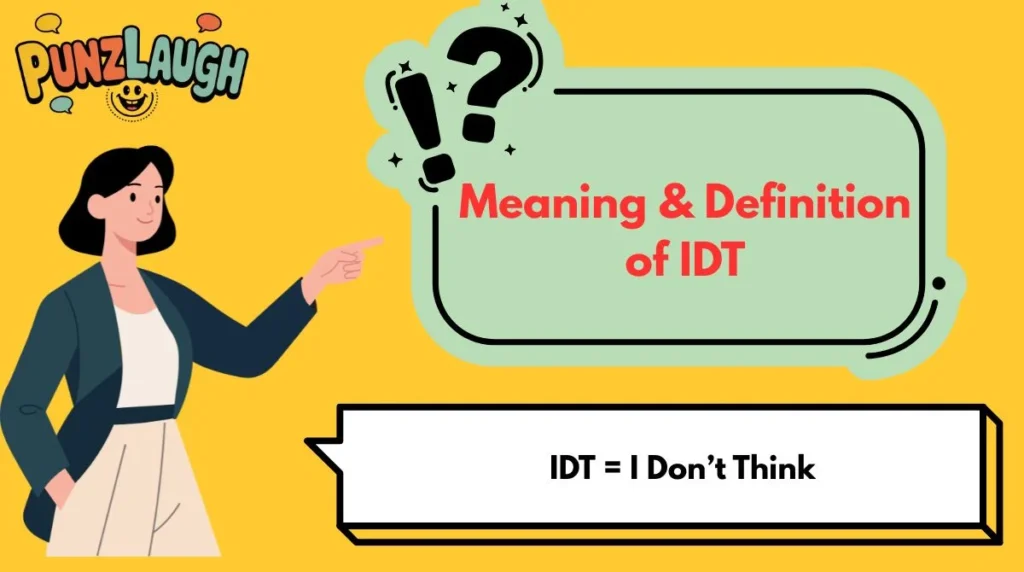
The most common IDT meaning in text is “I Don’t Think.” It is typically used to express uncertainty, polite disagreement, or a doubtful opinion. Instead of sounding blunt, IDT softens the tone of a response, making it feel more conversational.
Primary Meaning
- IDT = I Don’t Think
- Example: “IDT that movie is out yet.”
This version signals hesitation rather than a firm no. It often implies openness to discussion or correction.
Secondary Meanings
While rare, IDT can also stand for:
- I Don’t Trust (used in emotional or relationship contexts)
- I Doubt That (a more skeptical interpretation)
These meanings depend heavily on the surrounding message. Without context, IDT almost always defaults to I Don’t Think in casual texting.
Emotional Tone
- Neutral
- Polite
- Slightly hesitant
- Sometimes dismissive if overused
Understanding tone is key. Adding emojis or extra words can completely change how IDT is perceived in conversation.
Background & Origin of IDT
IDT originated from early SMS and instant messaging culture, where character limits encouraged shorter expressions. Like abbreviations such as BRB or IMO, IDT became popular because it saves time while still conveying a complete thought.
The phrase “I don’t think” has always existed in spoken English, but its abbreviated form gained traction in:
- Online chat rooms
- Early messaging apps
- Internet forums
As mobile texting became mainstream, IDT naturally fit into casual digital speech. Unlike slang that fades quickly, IDT stayed relevant because it mirrors everyday language and doesn’t rely on trends or pop culture.
Today, IDT is widely understood across age groups, especially among people who frequently text or use social media.
Usage in Different Contexts
Casual Chat
- Used to express doubt without sounding rude
- Example: “IDT I can make it tonight.”
Social Media
- Appears in comments or replies
- Keeps responses short and neutral
Professional or Semi-Formal Use
- Occasionally used in internal chats (Slack, Teams)
- Less common in emails or formal writing
Emotional Conversations
- Can soften disagreement
- Example: “IDT that’s what they meant.”
In professional settings, it’s often better to write the full phrase instead of using IDT to avoid sounding too casual.
Meanings Across Platforms
- Friendly and casual
- Often paired with emojis 😊
- Used in comments and DMs
- Short replies to opinions or questions
TikTok
- Appears in comment sections
- Used to react quickly to content
Snapchat
- Very common due to fast, informal messaging
- Often followed by clarification
Across platforms, the meaning stays consistent, but tone changes depending on emojis, punctuation, and context.
Other Fields: Technical Meanings of IDT
Outside texting, IDT can have completely different meanings:
- Physics / Engineering: Ignition Delay Time
- Medical: Infectious Disease Team
- Aviation: Integrated Drive Train
- Technology: Instruction Definition Table
These meanings are field-specific and rarely overlap with texting slang. Context makes all the difference.
Common Misconceptions & Mistakes
- Thinking IDT always means “I doubt that”
- Assuming it’s rude by default
- Using it in formal emails
- Misreading tone without context
Adding a short explanation after IDT can prevent confusion.
Similar Terms & Alternatives
| Abbreviation | Meaning | Tone |
|---|---|---|
| IMO | In My Opinion | Neutral |
| IDC | I Don’t Care | Blunt |
| IDK | I Don’t Know | Casual |
| I Doubt It | Full phrase | Direct |
How to Respond to IDT
Here are natural ways to reply:
- “Yeah, you might be right 🤔”
- “Why do you think that?”
- “Fair point!”
- “Maybe, but here’s what I found…”
Chat Examples
- A: “IDT that plan will work.”
- B: “Hmm, what part worries you? 😊”
Differences From Similar Words
IDT is softer than:
- “No”
- “That’s wrong”
- “I doubt it”
It leaves room for discussion, which makes it popular in polite conversations.
Relevance in Online Conversations & Dating Apps
On dating apps, IDT often signals hesitation or uncertainty:
- “IDT I’m ready for that yet.”
Understanding this helps you respond respectfully without pushing boundaries.
Popularity & Trends Over Time
Search interest for IDT meaning in text has grown steadily as:
- New users join social platforms
- Abbreviation-based communication increases
- Short-form messaging dominates online interaction
IDT remains stable because it’s practical, not trendy.
FAQs
What does IDT mean in texting?
It usually means “I Don’t Think.”
Is IDT rude?
No, but tone and context matter.
Can IDT mean something else?
Yes, but rarely outside technical fields.
Should I use IDT professionally?
Only in informal internal chats.
Is IDT still used today?
Yes, it’s common across messaging apps.
Conclusion
Understanding the IDT meaning in text helps you navigate modern digital conversations with confidence.
While it’s a simple abbreviation, IDT carries subtle emotional cues that can change how a message feels.
Most of the time, it means “I don’t think,” signaling doubt or polite disagreement rather than rejection.
Knowing when and how to use it, or how to respond, can improve communication in chats, social media, and even dating apps.
As online language continues to evolve, abbreviations like IDT remain relevant because they mirror how people naturally speak.
Once you understand its tone and context, IDT becomes an easy, useful part of everyday texting.

I am the pun-slinging mind behind PunZLaugh.com, turning everyday words into weirdly wonderful laughs.I am on a lifelong mission to make your day brighter—one groan-worthy pun at a time.